On 30 April 2026 BSI published an amendment to the British Standard for workplace first aid kits. The new reference is BS 8599-1:2019+A1:2026, and its title now covers "provision of automated external defibrillators (AEDs) in the workplace" as well as kit contents. If your first aid arrangements, policy or supplier paperwork still say "BS 8599-1:2019", this is what has changed and what you should do.
1. Defibrillators are now part of the standard
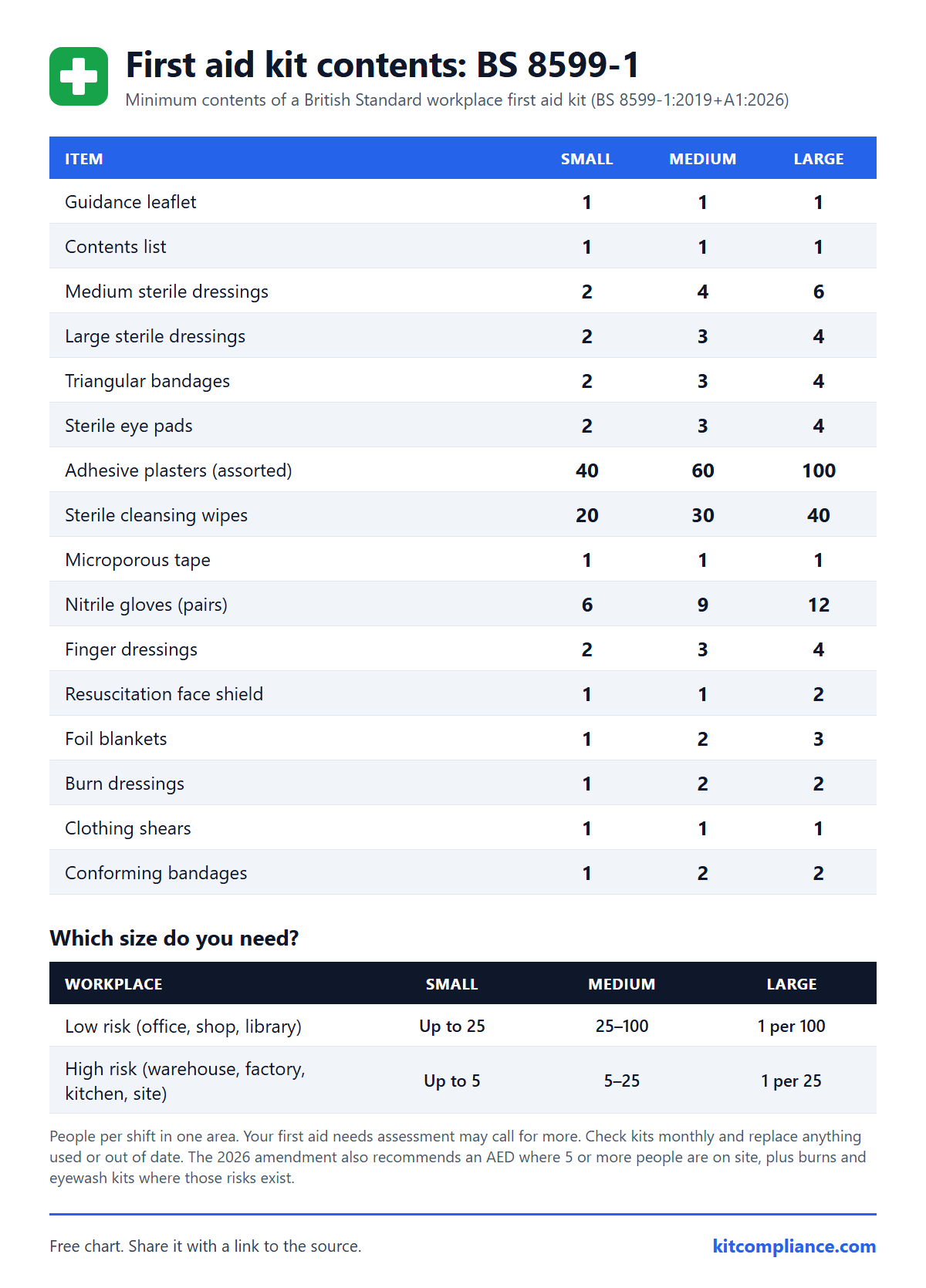
The biggest change is that BS 8599-1 now covers AEDs. According to supplier summaries of the amendment, it recommends that a workplace with 5 or more people on site during operating hours has an AED that is:
- reachable within about two minutes from every part of the workplace (a time, not a fixed distance, so large or multi-floor sites may need more than one);
- clearly displayed in a cabinet or wall unit; and
- available to the public where that is practical.
The 1981 First-Aid Regulations still don't mention AEDs, so this is not a new legal duty. But your needs assessment should now record whether you have one and, if not, why. Our guide to defibrillator requirements at work covers placement, and AED maintenance checks covers keeping the pads and battery in date.
2. New burns kits
The amendment introduces burns kits for workplaces with a higher identified risk of burns, such as kitchens, factories and laboratories. They carry burns dressings for when 20 minutes of cool running water isn't immediately available, and should be marked with the first aid symbol and "Burns". Standard kits still include burn dressings; see burns first aid at work.
3. New eyewash kits
Eyewash kits are expected wherever your risk assessment finds a risk to eyes, including from cleaning chemicals. Supplier summaries describe one eyewash kit alongside each medium or large first aid kit in lower-risk settings, and one with every kit in higher-risk ones. More on fixed stations and bottles in eyewash station requirements.
What hasn't changed
Suppliers report that the recommended contents of standard workplace kits are broadly the same as in the 2019 edition, with quantities still scaled by kit size. The size guide is also unchanged in principle: kit size depends on the most people in an area at once and how hazardous the work is.
What to do now
- Update your paperwork. Change references in your first aid policy and needs assessment from "BS 8599-1:2019" to "BS 8599-1:2019+A1:2026".
- Decide on an AED. If 5 or more people are on site, either provide one within two minutes' reach or record why your assessment doesn't need it.
- Check burns and eye risks. Add a burns kit or eyewash kit where your assessment finds those risks.
- Keep checking kits. Existing kits don't need replacing just because of the amendment, but they do need regular inspection and restocking.
Frequently asked questions
What changed in BS 8599-1 in 2026?
The amendment (BS 8599-1:2019+A1:2026, published 30 April 2026) extends the standard to defibrillators, recommending an AED where 5 or more people are on site and reachable within about two minutes, and introduces burns kits and eyewash kits. Standard kit contents are reported to be broadly unchanged.
Do I need to replace my 2019 first aid kits?
Not because of the amendment alone. A correctly stocked 2019 kit still matches the contents list. Review whether you now need an AED, a burns kit or an eyewash kit.
Is a defibrillator now a legal requirement at work?
No. BS 8599-1 is a standard, not a law, and the 1981 Regulations don't name AEDs. But a workplace with 5 or more people on site and no AED should record why in its needs assessment.