
Around 30,000 out-of-hospital cardiac arrests happen in the UK each year, and survival roughly halves for every minute that passes without CPR and defibrillation. That single statistic is why so many employers now ask the same question: do we legally have to have a defibrillator at work? The short answer is no, not automatically — but for a growing number of workplaces the honest answer to "should we?" is yes. This guide explains the legal position, when an AED is appropriate, where to put it, and the maintenance most workplaces forget.
What is an AED?
An AED — automated external defibrillator — is a portable device that analyses the heart's rhythm and, if it detects a shockable rhythm, delivers a controlled electric shock to try to restart a normal heartbeat. Modern AEDs are built for members of the public: they give spoken, step-by-step instructions, and they will not allow a shock unless one is genuinely needed, so you cannot hurt someone by using one wrongly. Used alongside CPR in the first few minutes, an AED is the single biggest factor in surviving a cardiac arrest.
The legal position in the UK
There is no standalone law that says "every workplace must have a defibrillator". What the law does say is broader:
- Health and Safety (First-Aid) Regulations 1981 — employers must provide "adequate and appropriate" first-aid equipment, facilities and people. Whether that includes an AED is decided by your needs assessment, not a fixed list.
- HSE guidance — the HSE does not mandate AEDs but supports their use, and expects you to have considered one where the risk justifies it.
- Resuscitation Council UK — recommends that AEDs be made available wherever people gather, and that access to defibrillation be built into workplace emergency plans.
So the duty is indirect but real: if your needs assessment shows an AED is appropriate and you don't provide one, you would struggle to argue your first-aid provision was adequate. The decision — and your reasoning — should be written down.
When should your workplace have a defibrillator?
An AED moves from "nice to have" to "you should really have one" as the following factors stack up. Work through them as part of your needs assessment:
| Factor | Why it points towards an AED |
|---|---|
| Large or dense workforce | The more people on site, the higher the statistical chance of a cardiac arrest in any given year. |
| Members of the public on site | Shops, gyms and leisure centres, venues and visitor-heavy sites greatly increase the number of people your provision covers — and in a gym, where members exert themselves, an AED is treated as near-essential. |
| Distance from emergency services | Rural or remote sites where an ambulance would take more than a few minutes make on-site defibrillation far more valuable. |
| Physically demanding or higher-risk work | Strenuous work, heat, and electrical hazards can all raise cardiac risk or cause arrest — an electric shock is a classic trigger. |
| Older or known-risk workforce | An ageing workforce or staff with known cardiac conditions shifts the balance towards having a device on hand. |
How to introduce and maintain a workplace AED
Deciding to get one is only the start — a defibrillator only saves a life if it is reachable, ready and in date. Follow these five steps:
- Decide through your needs assessment. Weigh the factors above and record why you did — or didn't — provide an AED.
- Choose the right unit. Semi- or fully-automatic, clear voice prompts, a suitable IP rating for the environment, and paediatric pads if children may be present.
- Site it for speed. Aim for a round trip of under 1–2 minutes from the areas it protects — an unlocked, well-signed spot everyone knows. A device three floors away in a locked cupboard helps no one. On larger sites, a first aid room is a natural home for it alongside other equipment.
- Register and sign it. Add it to The Circuit, the national defibrillator network, so ambulance services can direct 999 callers to it, and put up standard AED signage.
- Maintain it. Weekly status check, and track pad and battery expiry so it is never found flat or with dried-out pads.
Maintenance: the bit most workplaces miss
A defibrillator is not fit-and-forget kit. Two consumables silently expire:
- Pads — the adhesive gel dries out. They typically last 2–5 years and must be replaced after any use or once expired.
- Battery — loses charge over time. Depending on the model it lasts 2–7 years, and a flat battery means no shock when it matters.
Most AEDs run a self-test and show a green tick or flashing "ready" indicator — check it weekly and do a fuller, documented check monthly, at the same time you handle your first aid kit inspections. The failure mode is always the same: nobody notices the pads expired eighteen months ago until the day someone collapses. Tracking expiry dates is exactly the kind of thing that slips through paper logs. For the full routine — what to check weekly and monthly, and how to record it — see our defibrillator maintenance & checks guide.
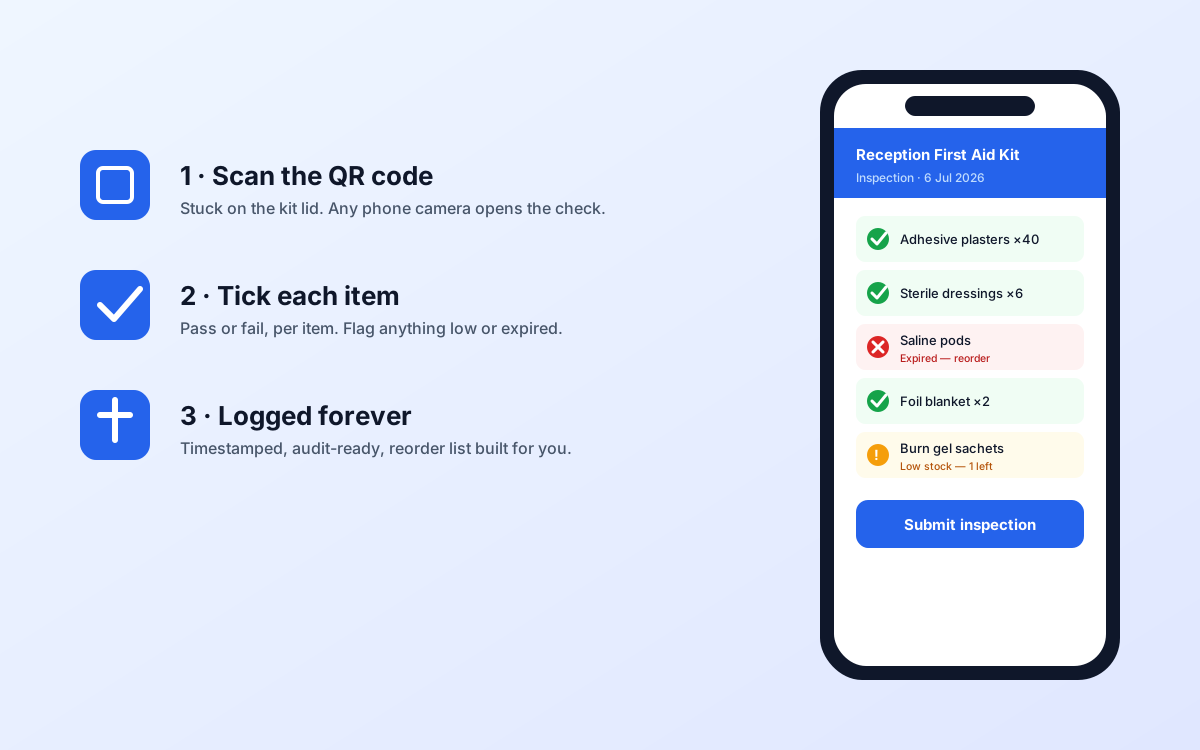
You can add your defibrillator, its pads and its battery to KitCompliance as tracked items with their own expiry dates. You'll get a reminder before either lapses, a logged record of every weekly and monthly check, and a one-click report that proves the device has been maintained — the evidence an ISO 45001 auditor or HSE inspector will want to see. See the getting-started guide to set it up.
Frequently asked questions
Are defibrillators a legal requirement in UK workplaces?
No. No law requires every workplace to have one. But the 1981 Regulations require "adequate and appropriate" first-aid provision, and your needs assessment may conclude an AED is appropriate — on a large, remote or public-facing site especially. The HSE and Resuscitation Council UK both encourage employers to consider one.
How often do defibrillator pads and batteries need replacing?
It depends on the model, but pads typically last 2–5 years and batteries 2–7 years, and both must be replaced after use or once expired. Pads dry out and batteries lose charge, so a device with lapsed consumables may fail when it's needed.
How often should a workplace AED be checked?
Do a visual status check weekly (most show a green tick when ready) and a fuller documented check monthly, alongside your other first-aid equipment. Record each one and act immediately on any problem.
Do you need training to use a defibrillator?
No qualification is required — AEDs are designed for untrained bystanders and talk you through each step, and won't shock unless it's needed. Including AED use in your FAW or EFAW training still builds confidence, and both courses now cover it as standard.