Almost every rule about workplace first aid — how many kits, what goes in them, how many first-aiders, whether you need a defibrillator — comes back to one document: your first aid needs assessment. The law never hands you a shopping list. Instead it tells you to work out what your own workplace needs, and to be able to show your reasoning. This guide walks through exactly how to do that, with a template you can copy.
What is a first aid needs assessment?
The Health and Safety (First-Aid) Regulations 1981 require every employer to provide "adequate and appropriate" first-aid equipment, facilities and personnel. "Adequate and appropriate" is deliberately not defined — a quiet office and a steelworks have very different needs. A first aid needs assessment is the process of deciding what those words mean for your site, and writing the answer down so you can prove it to an inspector, an auditor or an ISO 45001 assessor.
It doesn't need to be long or complicated. For a small low-risk business it might be a single page. What matters is that you have genuinely weighed the right factors and can act on the result. If you run more than one location, do a separate assessment for each — see first aid compliance across multiple sites.
Is it a legal requirement?
Yes — in practice. The Regulations require adequate provision, and HSE guidance is explicit that the way to arrive at it is a needs assessment. There is no separate "you must file this form" duty, but if something goes wrong and you cannot show you assessed your needs, you will struggle to demonstrate your provision was adequate. It is also one of the first things an ISO 45001 auditor asks to see.
The five factors to assess
HSE guidance points to five broad areas. Work through each one:
| Factor | What to consider |
|---|---|
| Nature of the work & hazards | Machinery, chemicals, electricity, working at height, hot processes, manual handling, driving. Higher hazards mean more first-aiders, higher-level training and extra equipment. |
| Workforce size & profile | Headcount, shift and night working, young or inexperienced workers, and anyone with a known medical condition or disability. |
| Site layout & spread | Building size, number of floors and buildings, travel distances, and separate or remote work areas that each need their own cover. |
| Access to emergency services | How quickly an ambulance could arrive. Remote or rural sites need more on-site capability and equipment such as an AED. |
| Lone, remote & travelling workers | People who work alone, off-site or drive for work need personal kits (see lone worker first aid requirements, remote & home workers and vehicle first aid kit requirements for BS 8599-2) and a way to raise the alarm. |
How many first-aiders do you need?
There's no fixed legal ratio — it falls out of the assessment (for a full breakdown by headcount, see how many first aiders you need). As a widely used HSE rule of thumb:
- Low-risk (offices, shops): an appointed person for fewer than 25 staff; at least one EFAW-trained first-aider for 25–50; one more for every extra 100.
- Higher-risk (warehousing, manufacturing, construction, catering): at least one FAW-trained first-aider for 5–50 staff; one more for every extra 50, plus specialised training where the hazard needs it.
Remember first-aiders take holidays and go off sick — build in enough cover that you are never left with none. For more on the difference between an appointed person, a first-aider and the employer's duty, see who is responsible for first aid at work.
Turning the assessment into provision
Once you've weighed the factors, decide and write down:
- Kits — how many, what size, and where. One within easy reach of every work area — see what should be in a workplace first aid kit.
- People — the number of first-aiders or appointed persons and their training level, with cover for absence.
- Extra equipment — AEDs (defibrillators), eye-wash stations, burn kits, vehicle kits, a catering kit for a kitchen, or — on a higher-risk site — a dedicated first aid room.
- Information — first-aid signs and notices telling staff where kits and first-aiders are.
- Records — how you'll keep kits stocked and evidence checks (see how often to inspect first aid kits).
A simple first aid needs assessment template
Copy this into a document, fill in each row, date it and keep it with your health-and-safety records:
| Section | Your answer |
|---|---|
| Site / location name | … |
| Number of employees (and max on any shift) | … |
| Risk level (low / higher) and main hazards | … |
| Lone / remote / travelling workers? | … |
| Distance / access to emergency services | … |
| Number & location of first aid kits | … |
| Number & training level of first-aiders | … |
| Additional equipment (AED, eye wash, etc.) | … |
| Assessed by / date / review date | … |
Reviewing your assessment
A needs assessment isn't a one-off. Review it at least once a year, and straight away whenever something changes: new equipment or processes, a jump in headcount, a new site or floor, a change of use, or an incident that revealed a gap. A quick note of "reviewed, no change" each year is fine — the point is to show it's live, not filed and forgotten. Many workplaces then write the conclusions up into a standing workplace first aid policy so staff know the arrangements and you can evidence them at a glance. When you review, it's worth checking the assessment against the wider workplace first aid compliance checklist so nothing downstream — first-aiders, kits, signage or records — has quietly lapsed.
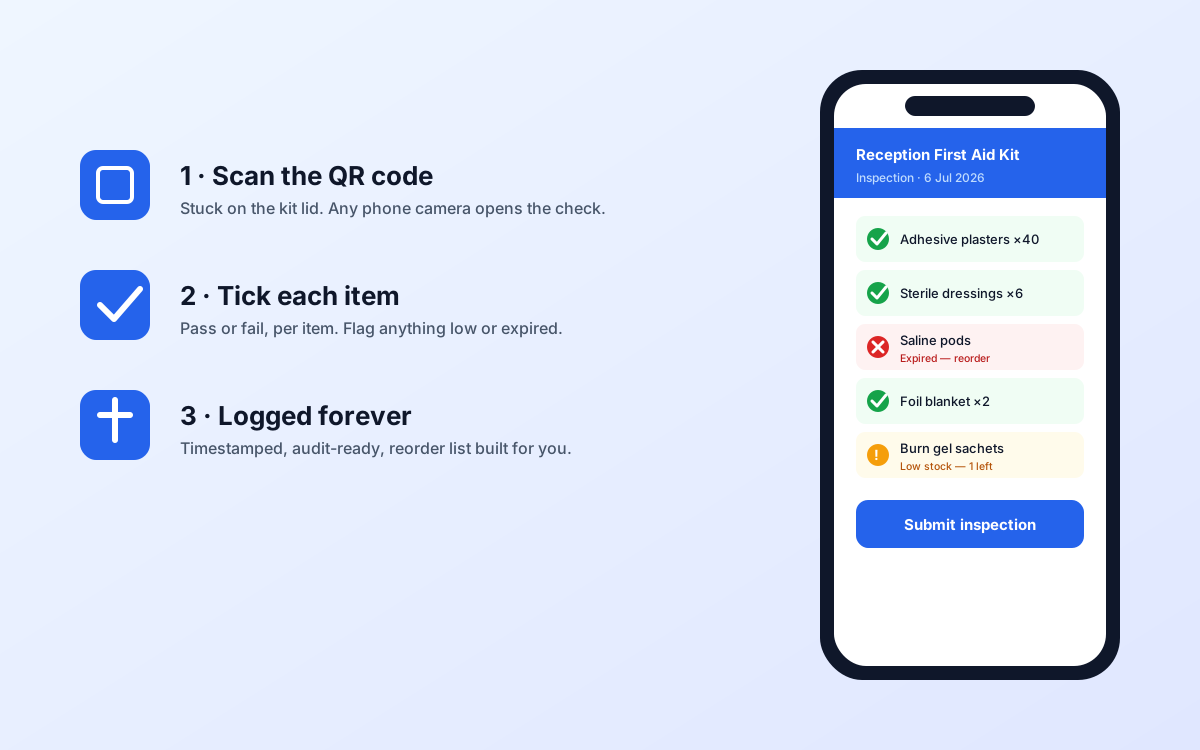
The assessment tells you what you need. Keeping it true day to day — every kit stocked, every certificate in date, every inspection logged — is where most workplaces slip. That's exactly what KitCompliance automates: build each kit from the ISO 45001 suggested list, record inspections in seconds, and get reminders before anything lapses, with a one-click report that proves your provision. See the getting-started guide to set it up.
Frequently asked questions
Is a first aid needs assessment a legal requirement?
Yes, in effect. The 1981 Regulations require "adequate and appropriate" provision, and a needs assessment is how you decide and evidence what that means for your workplace. The HSE expects you to have done one.
How many first aiders do I need?
There's no single legal ratio. As a guide, low-risk sites might need an appointed person under 25 staff, an EFAW first-aider for 25–50, and one more per extra 100; higher-risk sites need more, with FAW-level training. Your assessment sets the number.
How often should it be reviewed?
At least annually, and immediately after any material change — new processes or equipment, more people, a new site, or an incident.
Who should carry it out?
It's the employer's duty, usually delegated to whoever owns health and safety, ideally with input from staff who know the real hazards.