A gym is one of the few workplaces where the people most likely to collapse are the customers, not the staff. Members push their hearts hard on purpose, and a small number of them go into sudden cardiac arrest mid-session every year. That single fact shapes everything about first aid on a fitness site — and it's why a gym's provision has to go further than the office next door. This guide covers what UK law actually requires, why an AED is treated as near-essential, how many trained staff and what kit you need, and the pool and record-keeping rules that catch operators out.
The legal starting point
There is no gym-specific first-aid law. Gyms sit under the same framework as every other workplace: the Health and Safety (First-Aid) Regulations 1981, which require an employer to provide adequate and appropriate equipment, facilities and people so that employees who are injured or taken ill at work can be given immediate help.
Two things make "adequate and appropriate" mean more in a gym than in a low-risk office. First, the activity itself carries real risk — exertion, heavy weights, high footfall and water. Second, your premises are full of members of the public. The Regulations technically cover only your employees, but the HSE strongly recommends including non-employees in your assessment, and for a gym that recommendation is impossible to ignore: the members are the ones exercising, so they're the ones most likely to need help.
Start with a needs assessment
Every decision below flows from a first aid needs assessment. For a gym or leisure centre, weigh these site-specific factors:
| Factor | What it means for a gym |
|---|---|
| Cardiac risk | Members exercising at intensity can suffer sudden cardiac arrest. This is the defining hazard and the reason an AED is treated as essential. |
| Injury risk | Dropped weights, trips and falls, sprains and strains, crush injuries in the free-weights area, and machine-related injuries. |
| Water & pools | Any swimming pool adds drowning and near-drowning risk and its own qualified-lifeguard duty (see below). |
| Footfall & layout | Multiple floors, studios, a spin room, changing rooms and poolside each need cover within reach — not one kit at reception. |
| Opening hours & lone staff | 24-hour and early/late staffing, and lone workers opening or closing alone, need their own cover and a way to raise the alarm. |
Why an AED is near-essential in a gym
For most workplaces a defibrillator is a strong recommendation. For a gym it's close to a baseline expectation. When someone goes into cardiac arrest, survival falls by roughly ten percent for every minute without defibrillation — an ambulance almost never arrives fast enough on its own. An automated external defibrillator (AED) on the wall, combined with staff trained to use it, is what turns a collapse on the gym floor into a survivable event.
There's no statute that names gyms and orders an AED, but the Resuscitation Council UK and fitness-industry bodies expect them, and a proper needs assessment for a fitness site will reach the same conclusion. Fit at least one, keep it accessible and clearly signed, check its pads and battery in date, and make sure staff know where it is and how to use it. Treat the AED and its consumables as a tracked item, exactly like your kits.
How many first-aiders — and what training?
There's no legal ratio; the number falls out of your assessment (for the general rules of thumb, see how many first aiders you need). Because a gym is a higher-risk, public-facing site, plan for:
- At least one trained first-aider on duty every opening hour — including early mornings, late nights and weekends. More for large multi-floor sites or busy periods.
- CPR and AED skills as a priority. Whether staff hold an EFAW or a full FAW certificate, the cardiac-arrest response — CPR plus defibrillation — is the capability that matters most here.
- Qualified lifeguards (e.g. the NPLQ) for any pool, in the numbers your pool safety operating procedures require — on top of your general first-aiders, not instead of them.
- Cover for absence. First-aiders take holidays and go off sick; never let cover drop to zero on any shift.
In practice most instructors and personal trainers are already required to hold a current first-aid certificate by their qualification and insurer — but the employer still carries the duty to make sure enough trained people are actually on duty. For the difference between an appointed person, a first-aider and the employer's duty, see who is responsible for first aid at work.
Kit: what to provide and where
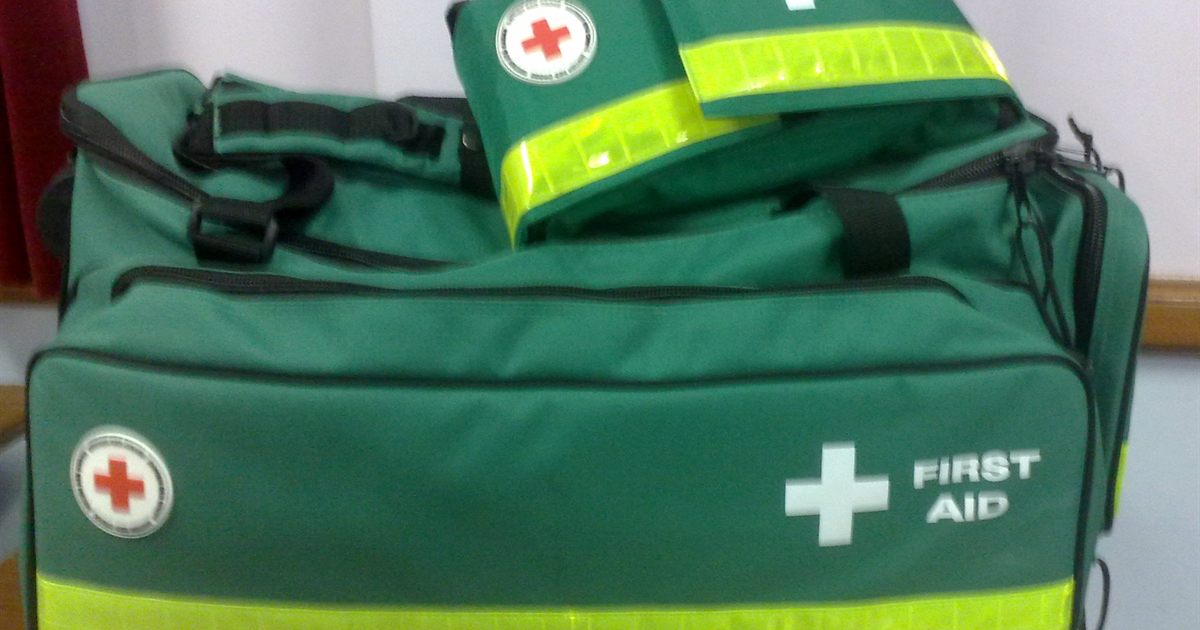
Provide BS 8599-1 workplace first aid kits in enough numbers and sizes for your headcount and footfall, positioned within easy reach of every area — the gym floor, studios, free-weights zone, reception and poolside. A single kit behind the desk isn't enough for a multi-room site.
Alongside the standard kits, a fitness site typically needs:
- An AED with spare pads, sited centrally and signed.
- Instant ice packs for the sprains and strains that are the gym's most common injury.
- Poolside provision — a kit rated for a wet environment plus any rescue equipment your pool procedures specify.
- A larger or dedicated provision if your assessment points to a first aid room on a big leisure centre.
Whatever you provide has to stay stocked and in date. Kits get raided for the odd plaster and their contents expire, so inspect them regularly and restock promptly.
Signs, records and reporting
Once your provision is in place, make it visible and provable:
- Signage — first-aid and AED signs so members and staff can find kits, the defibrillator and the nearest first-aider fast.
- Accident book — record every injury to staff or members. Keep entries compliant with data-protection rules (see the accident book and RIDDOR).
- RIDDOR reports — certain serious incidents to employees, and incidents to members that result in them being taken to hospital, are reportable to the HSE. Know which ones and report on time.
- Inspection logs — dated evidence that kits and the AED are checked and in date, so you can prove provision at a glance.
Quick gym first aid checklist
| Item | In place? |
|---|---|
| Written needs assessment covering staff and members | … |
| AED fitted, accessible, signed and in date | … |
| Trained first-aider on duty every opening hour | … |
| Qualified lifeguards for any pool | … |
| BS 8599-1 kits at gym floor, studios, poolside, reception | … |
| Ice packs and any pool-specific equipment | … |
| First-aid and AED signage displayed | … |
| Accident book, RIDDOR process and inspection logs | … |
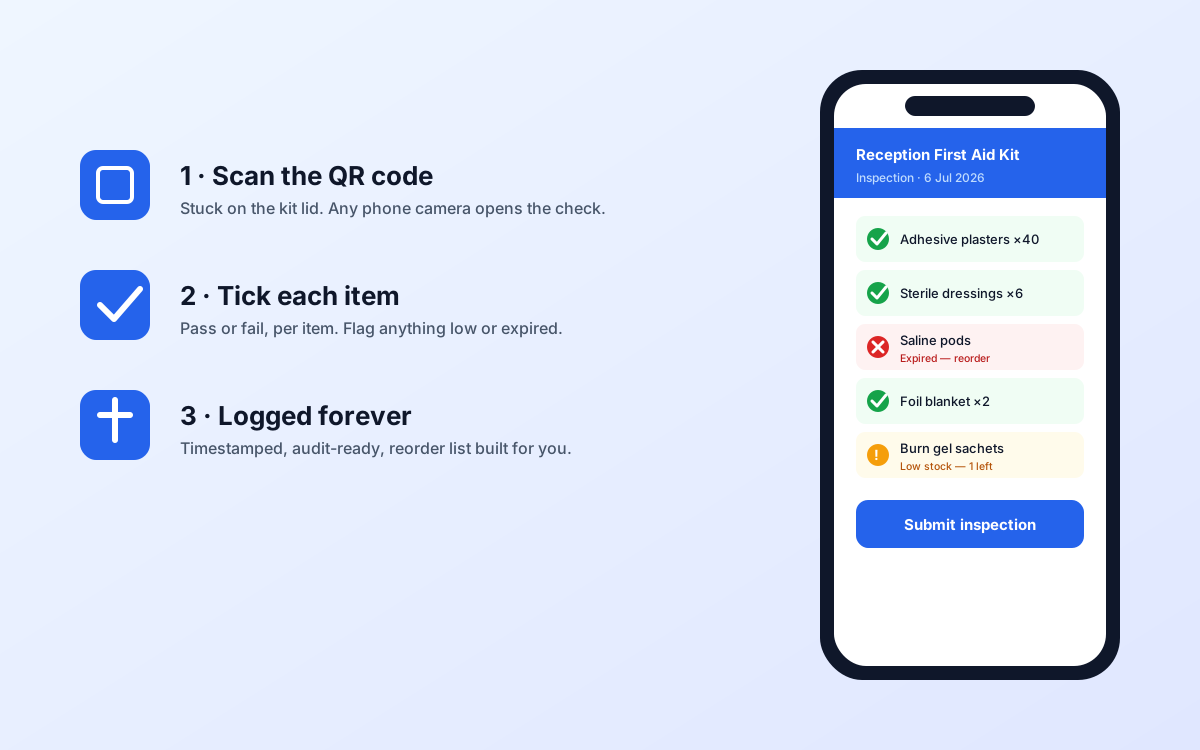
A gym's first-aid burden isn't the paperwork on day one — it's keeping it true across long opening hours and multiple areas: every kit stocked, the AED pads in date, every inspection logged, every first-aider's certificate current. That's exactly what KitCompliance automates. Build each kit — gym floor, poolside, reception, the AED — from the ISO 45001 suggested list, record checks in seconds, and get reminders before anything lapses, with a one-click report that proves your provision. See the getting-started guide to set it up.
Frequently asked questions
Is a defibrillator a legal requirement for a gym in the UK?
No single law names gyms and orders an AED, but the 1981 Regulations require provision that is adequate for your risks — and sudden cardiac arrest during exertion is a gym's signature risk. The Resuscitation Council UK and industry bodies expect gyms to have one, and a needs assessment for a fitness site will almost always conclude the same, so it's treated as essential.
How many first aiders does a gym need?
There's no fixed ratio — it comes out of your assessment. As a higher-risk, public-facing site, plan for at least one trained first-aider on duty every opening hour, more for larger or busier sites, plus qualified lifeguards for any pool and cover for absence.
Do gym staff need first aid training?
Instructors and personal trainers are usually required to hold a current first-aid certificate covering CPR and AED use by their qualification and insurer. The employer must still ensure enough trained first-aiders are actually on duty at all times.
Do members and the public count?
The Regulations strictly cover employees, but the HSE strongly recommends including non-employees. In a gym the members are the ones exercising and most at risk, so sensible provision is planned around them, not just staff.