Almost every rule about first aid at work in Great Britain traces back to a single piece of law: the Health and Safety (First-Aid) Regulations 1981. It's short, it's deliberately non-prescriptive, and it's the reason there's no simple legal checklist telling you exactly how many kits or first-aiders to have. This guide translates the Regulations into plain English — what they actually say, who they cover, what "adequate and appropriate" means in practice, and the five steps to comply.
What are the First-Aid Regulations 1981?
The Regulations sit under the Health and Safety at Work etc. Act 1974 and apply to almost every workplace in Great Britain. The core duty is in Regulation 3: every employer must provide "such equipment and facilities as are adequate and appropriate in the circumstances" for giving first aid to employees, and — where appropriate — suitable people to give it. Two words carry all the weight: adequate and appropriate. They are never defined in numbers, because a quiet office and a steel foundry plainly need very different provision.
That vagueness is the whole point. Rather than a one-size checklist, the law asks you to judge what your workplace needs and to keep that judgement current. The HSE publishes an Approved Code of Practice and guidance (document L74) that explains how to reach a sensible answer, but the guidance is advice, not a rigid rulebook.
The core duties, in plain English
| Regulation | What it means for you |
|---|---|
| Reg 3 — Employer's duty | Provide adequate and appropriate first-aid equipment, facilities and personnel for your employees. This is the main obligation and the source of the "adequate and appropriate" standard. |
| Reg 3 — Appointed person | Where a trained first-aider isn't warranted, you must still appoint a person to take charge of arrangements and equipment and to call the emergency services (see appointed person duties). |
| Reg 4 — Self-employed | Self-employed people must ensure there's adequate and appropriate equipment to give themselves first aid while at work. |
| Reg 5 — Informing employees | Tell staff the first-aid arrangements — who the first-aiders are and where the equipment is — usually through first-aid notices. |
What does "adequate and appropriate" mean?
Because the phrase isn't defined, the only way to pin it down is a first aid needs assessment. HSE guidance points to the factors that push provision up or down:
- The nature of the work and its hazards — a low-risk office needs far less than a construction site or a workshop.
- The size and profile of the workforce — headcount, shift patterns, young or inexperienced workers, known health conditions.
- Site layout and spread — multiple floors, buildings, or remote areas each need their own cover and kits.
- Access to emergency services — remote or rural sites may need more on-site capability, including a defibrillator.
- Lone, remote and travelling workers — who need personal kits and a way to raise the alarm.
The output is your decision on how many kits and what goes in them, how many first-aiders and at what training level, and any extra equipment — written down and reviewed.
Who has to comply?
Every employer in Great Britain, whatever the size — the Regulations apply from a single employee upwards. There is no small-business exemption: even a two-person firm must have at least an appointed person and a suitably stocked kit. The self-employed must provide for themselves under Regulation 4. Northern Ireland has its own, near-identical rules (the Health and Safety (First-Aid) Regulations (Northern Ireland) 1982).
How to comply, in five steps
- Do a needs assessment. Weigh the factors above and write down what's adequate and appropriate — this is the foundation everything else rests on.
- Provide the equipment. A correctly sized, stocked kit within easy reach of every work area, plus any extra equipment your assessment calls for.
- Appoint people. FAW or EFAW-trained first-aiders where the risk warrants, or at least an appointed person for low-risk workplaces.
- Inform employees. Put up notices saying who and where the first-aid help is.
- Keep it true and review it. Keep kits inspected and stocked, certificates in date, and revisit the assessment whenever things change.
What if you don't comply?
A breach of the First-Aid Regulations is an offence under the Health and Safety at Work etc. Act 1974. The HSE (or the local authority, for some sectors) can serve improvement or prohibition notices and, in serious cases, prosecute — with unlimited fines. Most enforcement follows an incident where provision turned out to be inadequate and the employer couldn't show they'd assessed and met their duty. Keeping a dated needs assessment and evidence that kits and training are current is your best defence.
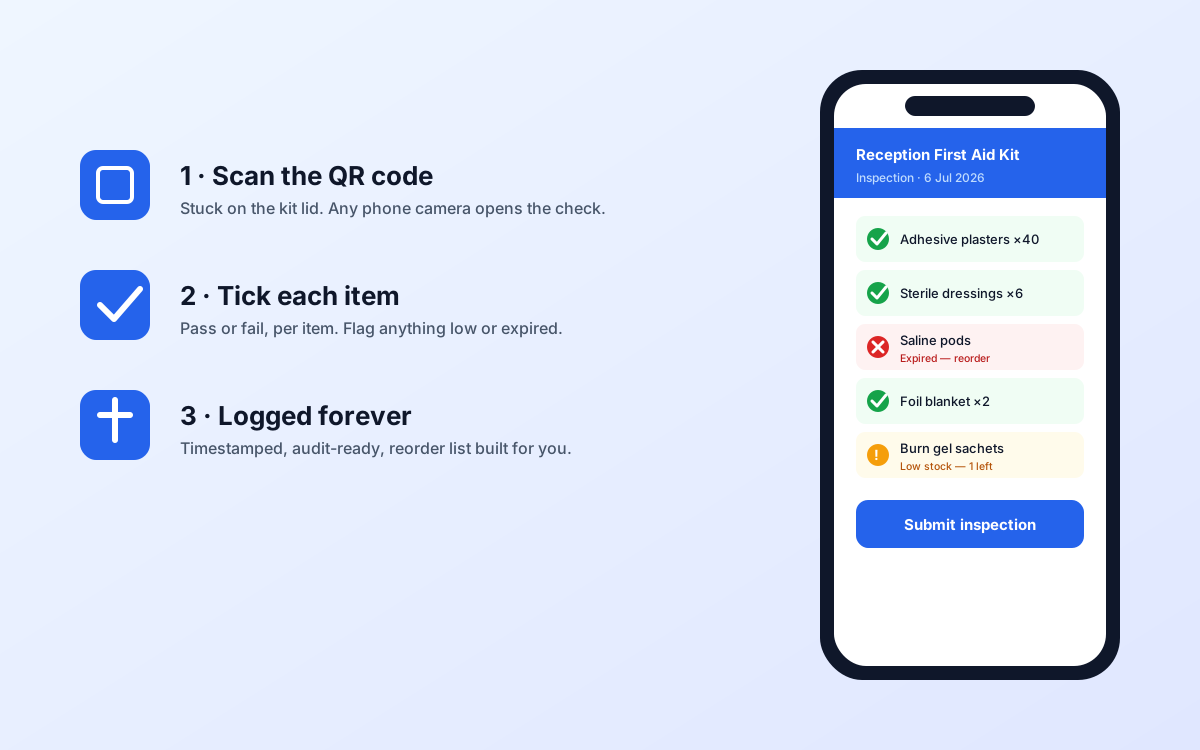
The Regulations set the duty; the hard part is keeping it true day to day — every kit stocked, every certificate in date, every inspection logged and provable. That's exactly what KitCompliance automates: build each kit from the ISO 45001 suggested list, record inspections in seconds, and get reminders before anything lapses, with a one-click report that evidences your provision. See the getting-started guide to set it up.
Frequently asked questions
What do the First-Aid Regulations 1981 require?
Every employer must provide "adequate and appropriate" first-aid equipment, facilities and people so injured or ill employees get immediate help. What's adequate and appropriate is decided by a needs assessment of your own workplace.
Do the Regulations cover the self-employed?
Yes — Regulation 4 requires the self-employed to have adequate and appropriate equipment to give themselves first aid at work. The rules don't legally require you to provide for non-employees, but the HSE recommends including them.
Is a first-aider a legal requirement?
Not automatically. The Regulations require a suitable person to take charge of arrangements. Whether they need FAW or EFAW training or are simply an appointed person depends on your risk level and size, set by the needs assessment.
What happens if you breach them?
It's a criminal offence under the 1974 Act. The HSE can serve notices or prosecute, with unlimited fines — usually after an incident exposed inadequate provision.