"How many first aiders do I need?" is one of the most common questions UK employers ask — and the honest answer is that there is no fixed legal number. The law asks you to provide "adequate and appropriate" cover and to work out what that means for your own workplace. The good news: the HSE publishes clear, risk-based numbers you can start from, and this guide turns them into a table you can read your answer straight off.
Is there a legal minimum number of first aiders?
No. The Health and Safety (First-Aid) Regulations 1981 deliberately avoid a fixed ratio because a quiet office and a busy warehouse have very different risks. Instead they require "adequate and appropriate" equipment, facilities and people, and leave you to decide the number through a needs assessment. That means a single figure — "you must have X first-aiders" — doesn't exist in law. What does exist is HSE guidance giving suggested numbers by risk level and headcount, which is what inspectors and auditors expect you to have worked from.
The HSE ratio table (start here)
Match your risk level to the maximum number of people at work at once — not just the total on the payroll — and read across:
| Risk level | People at work | Suggested provision |
|---|---|---|
|
Low risk offices, shops, libraries |
Fewer than 25 | At least one appointed person |
| 25–50 | At least one EFAW-trained first-aider | |
| More than 50 | One FAW-trained first-aider per 100 employees (or part thereof) | |
|
Higher risk construction, manufacturing, warehousing, catering, food processing |
5–50 | At least one FAW-trained first-aider |
| More than 50 | One FAW-trained first-aider per 50 employees (or part thereof) |
Worked examples
Reading the table for a few real workplaces:
- A 12-person accountancy office (low risk): fewer than 25 low-risk staff — an appointed person is the suggested minimum. In practice most train one EFAW first-aider anyway, plus a second for cover (see office first aid requirements and first aid for small businesses for the full low-risk baseline).
- A 40-person call centre (low risk): 25–50 low-risk staff — at least one EFAW-trained first-aider.
- A 30-person builders' merchant (higher risk): 5–50 higher-risk staff — at least one FAW-trained first-aider (see warehouse first aid requirements for spreading cover across shifts and a big floor).
- A 120-person food factory (higher risk): more than 50 higher-risk staff — one FAW first-aider per 50, so at least three — before adding cover for shifts and absence.
Factors that push the number up
The table gives a floor, not a ceiling. HSE guidance says to add to it whenever these apply:
| Factor | Why it needs more first-aiders |
|---|---|
| Holidays & sickness | You must have cover at all times, so never rely on a single person — train enough that annual leave or illness never leaves you with nobody. |
| Shift working | Every shift — including nights and weekends — needs its own cover, not just the day shift. |
| Spread-out or multi-floor sites | A first-aider must be able to reach a casualty quickly, so large buildings and separate areas each need their own. |
| Multiple buildings or sites | Each location generally needs its own cover on site. |
| Higher or specialised hazards | Chemicals, confined spaces or hazardous machinery may call for more first-aiders and additional training (e.g. for specific injuries). |
| Members of the public on site | HSE strongly recommends you factor in non-employees such as visitors, customers and pupils. |
Running a one-off event is the extreme version of this: a temporary crowd, often outdoors, with cover set by risk-scoring rather than the staff ratio above — see event first aid requirements for the crowd-size ratios and the Purple Guide method.
How to calculate your own number
Turn the guidance into a figure you can defend in four steps — this is the core of a needs assessment:
- Decide your risk level — low (office/retail) or higher (industrial, construction, catering).
- Count the most people at work at once — use the busiest shift, not the payroll total.
- Read the starting number off the table above for that risk level and headcount.
- Adjust upward for absence cover, shifts, spread-out or multiple sites, and any specific hazards — then record the final number and how you reached it.
First aiders are only half of it
Having enough trained people is one duty; having the kits and equipment they need — stocked, in date and regularly inspected — is the other. A first-aider with an empty or expired kit can't do their job, and a lapsed certificate quietly drops your cover below the number you assessed.
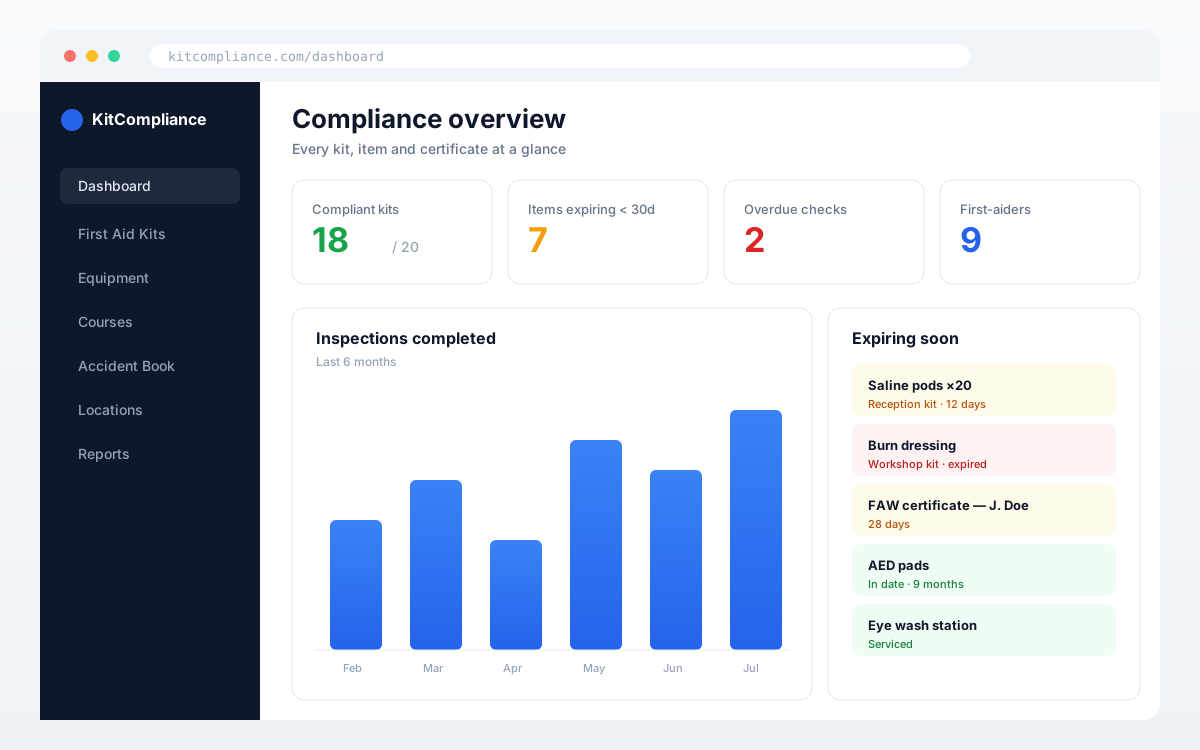
KitCompliance keeps the whole picture provable: log each first-aider and their EFAW/FAW certificate expiry, build every kit from the suggested BS 8599-1 list, record inspections in seconds, and get reminders before a certificate or a kit item lapses — with a one-click report that shows your provision matches your assessment. See the getting-started guide to set it up.
Frequently asked questions
How many first aiders do I legally need in the UK?
There's no fixed legal ratio. The 1981 Regulations require "adequate and appropriate" provision decided by a needs assessment. As HSE guidance: low-risk sites need an appointed person under 25 staff, an EFAW first-aider for 25–50, and one more per extra 100; higher-risk sites need a FAW first-aider for 5–50 staff and one more per extra 50.
Is one first aider enough for a small business?
It can be adequate for a small low-risk workplace, but one is rarely enough on its own — first-aiders take holidays and get ill, and you must have cover at all times. Most small businesses train a second person for this reason; see first aid cover during holidays and staff absence for how much spare to build in.
Do I need a first aider on every shift?
Yes. Cover has to reach everyone at work, so night, evening and weekend shifts each need their own first-aider or appointed person — not just the day shift.
What's the difference between an appointed person and a first aider?
An appointed person takes charge in an emergency and looks after the equipment but needs no formal training; a first-aider holds a valid EFAW or FAW certificate. Very small low-risk workplaces may rely on an appointed person, but most need trained first-aiders.