Agriculture is the most dangerous industry to work in in Britain. Year after year, HSE figures put the fatal-injury rate on farms at roughly twenty times the average across all industries — moving machinery, livestock, falls, and being struck by objects account for most of the deaths. When help is a workshop, a field or a valley away and an ambulance is half an hour off, the first aid on your farm has to do more than a green box on an office wall. This guide covers what the law expects: who's responsible, how many first-aiders and kits you need, and how to keep cover across buildings, vehicles and lone workers.
Is first aid a legal requirement on a farm?
Yes. The Health and Safety (First-Aid) Regulations 1981 require every employer to provide "adequate and appropriate" first-aid equipment, facilities and people for their workers — the same duty that governs every UK workplace. "Adequate and appropriate" is deliberately not defined, because a quiet office and a working farm have very different needs. Because agriculture is explicitly treated as high-risk, your provision must sit well above the office baseline.
Farms are unusual in one respect: a large share of the people working on them are self-employed — sole traders, family members and contractors. The 1981 Regulations don't require a self-employed person to provide first aid for other people, but the Health and Safety at Work etc. Act 1974 still requires them to look after their own health and safety, and to cooperate with anyone else working on the holding. Given how much farm work is done alone and miles from help, that's a strong practical reason to carry a proper kit whether the law names you as an employer or not.
Why a farm counts as high-risk
Your needs assessment starts from the hazards, and on a farm the list is long and serious. The injuries a farm kit and first-aiders have to be ready for aren't paper cuts:
| Hazard | Why it matters for first aid |
|---|---|
| Vehicles & machinery | Tractors, telehandlers, quad bikes and PTO shafts cause overturns, crush injuries, entanglement and serious bleeds — the single biggest cause of farm deaths. |
| Livestock | Cattle in particular kick, crush and trample. Handling injuries can be sudden and severe, often in a yard or field away from the farmhouse. |
| Falls from height | Barn roofs, fragile roof lights, ladders, bale stacks and grain-store walkways lead to falls and head injuries. |
| Slurry & confined spaces | Slurry stores and tanks release toxic hydrogen sulphide gas that can overcome someone in seconds — a rescue-and-resuscitation scenario, not a plaster. |
| Chemicals & dust | Pesticides, veterinary medicines, fuels and grain dust put eyes, skin and lungs at risk — see eyewash station requirements. |
| Remote, lone & long-hours working | Much of the work is done alone, far from the yard, at harvest or lambing when hours are long and fatigue high — and an ambulance may be a long way off. |
How many first-aiders does a farm need?
There's no fixed legal ratio — it falls out of your needs assessment — but because farming is high-risk, the HSE points to stronger cover than a low-risk office. As a rule of thumb for high-risk work:
- The smallest holdings — a one- or two-person family farm might meet the legal minimum with an appointed person (someone to take charge, call an ambulance and look after the kit), but given the hazards and slow response times a trained first-aider is strongly advised, not just nice to have.
- 5–50 workers — at least one First Aid at Work (FAW) trained first-aider. FAW is the three-day qualification rather than the one-day EFAW, which is the level the hazards on a farm justify.
- More than 50 workers — one additional FAW first-aider for every extra 50, plus cover that follows seasonal peaks.
Two things make farms harder than the headcount suggests. First, numbers swing with the season — a farm that runs on two people for most of the year takes on gangs at harvest, lambing or picking, and your cover has to scale with them. Second, people work alone, so one first-aider "on the farm" is no use to someone injured two fields away. For worked examples by headcount, see how many first aiders do I need.
What first aid kits does a farm need?
Use British Standard BS 8599-1 workplace kits, sized to the number of people and placed within easy reach of every work area — not one box in the farmhouse. A typical farm needs kits in several places at once:
- The farmhouse or office, the main workshop, and each separate building (parlour, grain store, packhouse) — sized using our BS 8599-1 size guide.
- A travelling kit (BS 8599-2) in every tractor, telehandler, quad bike and van — the same standard that covers work vehicles and fleets. This is the kit that reaches the field.
- A personal kit for anyone working out on their own.
On top of the standard contents (see what should be in a workplace first aid kit), farms commonly add extras driven by the real hazards:
- Large trauma / wound dressings and, where the assessment supports it, a tourniquet and haemostatic dressing for serious bleeds from machinery entanglement or livestock injuries.
- Burn dressings for hot work, engines, welding and chemical burns.
- Eye wash for dust, grain, slurry splashes, pesticides and veterinary products.
- Foil blankets for shock and exposure, since a casualty may be outdoors for a while before help arrives — cold, wet outdoor work also makes hypothermia & cold stress a real risk.
Remote sites, lone working and slow ambulances
The defining problem on a farm is distance. A casualty may be alone, out of sight and earshot, and a long way from a road an ambulance can use. Provision has to be built around that:
- Give lone and remote workers a personal kit and a reliable way to raise the alarm — a charged phone or radio, a check-in routine, and a way to share an exact location (a what3words reference or grid location speeds up an ambulance enormously on open land). See lone worker first aid requirements for how to assess this properly.
- Because rural ambulance response is slower, seriously consider a defibrillator (AED) — early defibrillation is the single biggest factor in surviving a cardiac arrest, and the minutes you save on a farm can be decisive. See are defibrillators a legal requirement at work.
- Make sure everyone knows the farm's address, postcode and location references and where the kits and AED are — precious time is lost directing an ambulance down the wrong track.
This is the same higher-risk, spread-out logic that applies on a construction site or across a factory — the difference on a farm is the sheer distance and the amount of solo work.
Setting it up: a quick checklist
Pulling it together, first-aid provision on a farm should cover:
- A written needs assessment treating the farm as high-risk and listing the real hazards — machinery, livestock, heights, slurry, chemicals, lone working.
- Enough FAW-trained people for the busiest season, including family and seasonal workers, with cover for absence.
- BS 8599-1 kits in every building plus BS 8599-2 travelling kits in every vehicle, with burn, eye-wash and trauma extras.
- Lone-worker cover — personal kits, a way to raise the alarm, and a way to pinpoint a location fast.
- A defibrillator where practical, and clear signage showing where kits and the AED are.
- An accident book and RIDDOR process, plus regular checks and restocking so nothing is empty or expired when you need it.
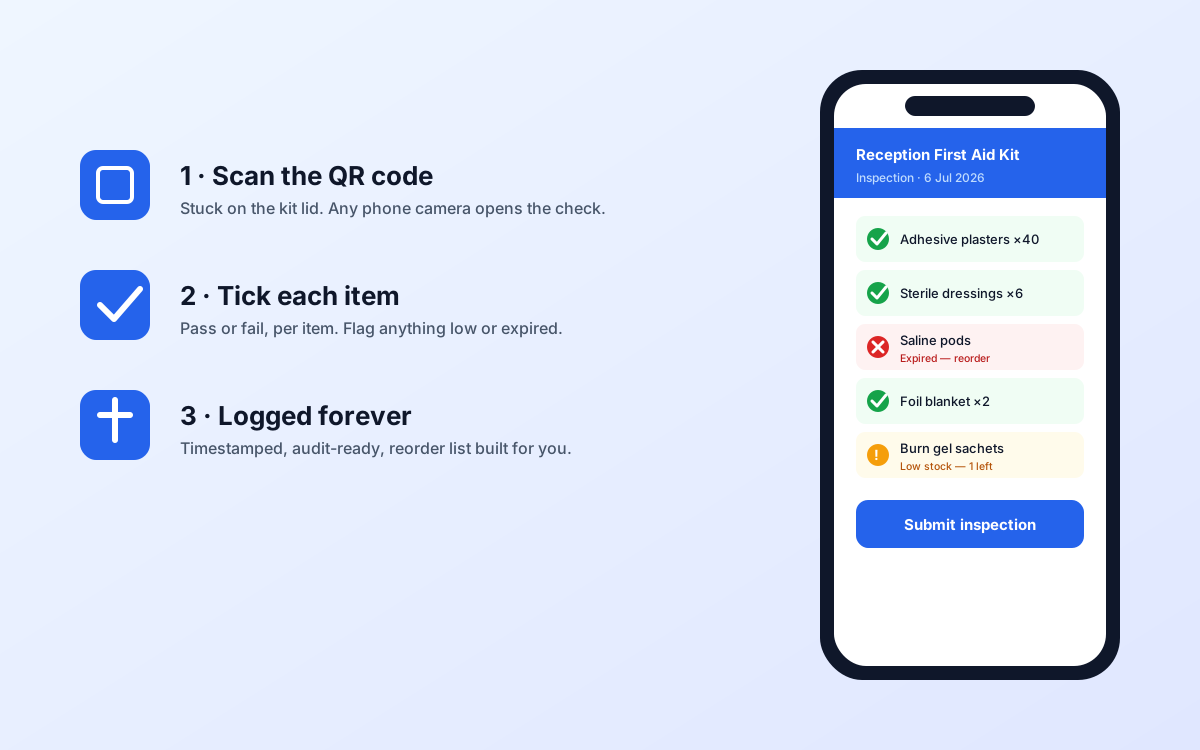
The hard part on a farm isn't deciding the provision — it's keeping it true across kits scattered over buildings and vehicles that spend the day in the field. Kits get raided mid-job, dressings expire in a hot cab, and a travelling kit that left with a contractor is easy to forget. That's exactly what KitCompliance automates: build each kit from the BS 8599-1 / BS 8599-2 suggested list, log inspections in seconds from a phone in the yard, get reminders before anything lapses, and produce a one-click report that proves your provision. See the getting-started guide to set it up.
Frequently asked questions
Is first aid a legal requirement on a farm?
Yes. The 1981 First-Aid Regulations require adequate and appropriate provision for every worker, and because agriculture is high-risk that means more than the office minimum. Self-employed farmers must also provide for their own health and safety under the 1974 Act.
How many first-aiders does a farm need?
There's no fixed ratio. A tiny family farm may legally meet the minimum with an appointed person, but a trained first-aider is strongly advised. Higher-risk guidance points to at least one FAW-trained first-aider for 5–50 workers, scaled up for seasonal peaks and lone working. Your needs assessment sets the number.
What should be in a farm first aid kit?
BS 8599-1 kits in the buildings and BS 8599-2 travelling kits in every vehicle, plus extras such as large trauma dressings, burn dressings, eye wash and foil blankets based on the farm's hazards.
Are self-employed farmers covered by first aid rules?
They don't have to provide first aid for other people under the 1981 Regulations, but must look after their own health and safety under the 1974 Act. Given how much farm work is done alone, a good personal kit and a way to raise the alarm are essential in practice.