A factory is one of the clearest cases of higher-risk work in UK health and safety. Machinery with moving parts, hot processes, chemicals, pressure and constant manual handling mean an injury on the shop floor is more likely — and more likely to be serious — than in an office. The law that governs first aid is the same everywhere, but what counts as "adequate and appropriate" on a production line is a long way above the office minimum. This guide covers exactly what a manufacturing site needs and how to prove it.
Why manufacturing counts as higher-risk
The Health and Safety (First-Aid) Regulations 1981 require every employer to provide "adequate and appropriate" first-aid equipment, facilities and people. "Adequate and appropriate" is deliberately not defined — it scales with the hazards, and a factory has hazards a low-risk workplace simply does not. The same higher-risk logic applies on a construction site, in a warehouse and in a vehicle workshop; on a production line it is driven by different injuries:
| Hazard | Why it matters for first aid |
|---|---|
| Machinery & moving parts | Guillotines, presses, conveyors and rollers cause crush, amputation and entanglement injuries — often severe and time-critical, needing a trained first-aider fast. |
| Hot work & hot surfaces | Welding, moulding, ovens and molten material cause burns and scalds that need immediate, correct treatment and the right dressings on hand. |
| Chemicals & substances | Solvents, acids, coolants and dust cause eye injuries, skin damage and inhalation harm — which is why eye wash is so often needed on a factory floor. |
| Manual handling & repetitive work | Strains, back injuries and cuts from lifting, loading machines and breaking down materials. |
| Noise, pressure & electrical | Pressure systems, compressed air and electrical work add blast, shock and hearing-related risks that raise the profile further. |
| Heat & hot environments | Ovens, furnaces and poorly ventilated lines can cause heat exhaustion and heat stroke, especially in PPE or during summer — first-aiders need to cool a casualty fast. |
How many first-aiders does a factory need?
There is no fixed legal ratio — the number falls out of your needs assessment (for the full breakdown by headcount, see how many first aiders you need). As a widely used HSE rule of thumb for higher-risk sites:
- At least one FAW-trained first-aider for 5–50 workers.
- One more FAW first-aider for every extra 50 beyond that.
- Specialised cover where a hazard needs it — for example someone trained to deal with specific chemicals used on site.
The critical point in manufacturing is that the count is per shift. A plant running double days, nights or weekends needs trained first-aiders on every shift, not just a headcount that looks fine on paper during the day. Build in cover for holidays and sickness too — first-aiders take leave, and if lapsed certificates or absence drop you below the number your assessment set, your provision is no longer adequate even though nothing on the floor has changed. Keep an eye on certificate expiry dates so cover never quietly falls short.
Kits and equipment for a production site
Base kit sizing on BS 8599-1 and headcount — usually large (100-person) kits — and provide several, spread so one is within easy reach of every production area rather than one box by the door (see how many first aid kits you need and BS 8599-1 sizes). On top of the standard kit, a factory almost always needs hazard-specific provision:
- Burns kits near hot processes — welding bays, moulding, ovens and furnaces — stocked with the right burns dressings (see burns first aid at work).
- Eye wash stations wherever chemicals, coolants or dust are handled — mains-fed stations where possible, sterile bottles elsewhere (see eye wash station requirements).
- An AED (defibrillator) where the assessment supports it — large sites, physical work and long ambulance times all point towards one (see workplace defibrillator requirements).
- A bleed control kit where cutting, pressing or moving machinery creates a real risk of catastrophic bleeding (see bleed control kit requirements).
- A first aid room on larger or higher-hazard sites, where treating someone properly needs more than a wall-mounted kit (see first aid room requirements).
How to set your factory's first aid provision
Work through it in five steps and write the result down:
- Treat the site as higher-risk. List the machinery, hot work, chemical and handling hazards and record them in a first aid needs assessment.
- Set first-aider numbers per shift. Apply the higher-risk ratio above to the maximum on any shift, with cover for absence.
- Place kits by the hazards. One within reach of every production area, plus burns kits and eye wash where the process needs them.
- Add higher-risk equipment. AED, eye wash, burns provision and a first aid room where size and hazard support them.
- Record, train and review. Keep certificates in date, log kit inspections, put up first-aid signs so staff know where cover is, and review whenever machinery, processes or headcount change.
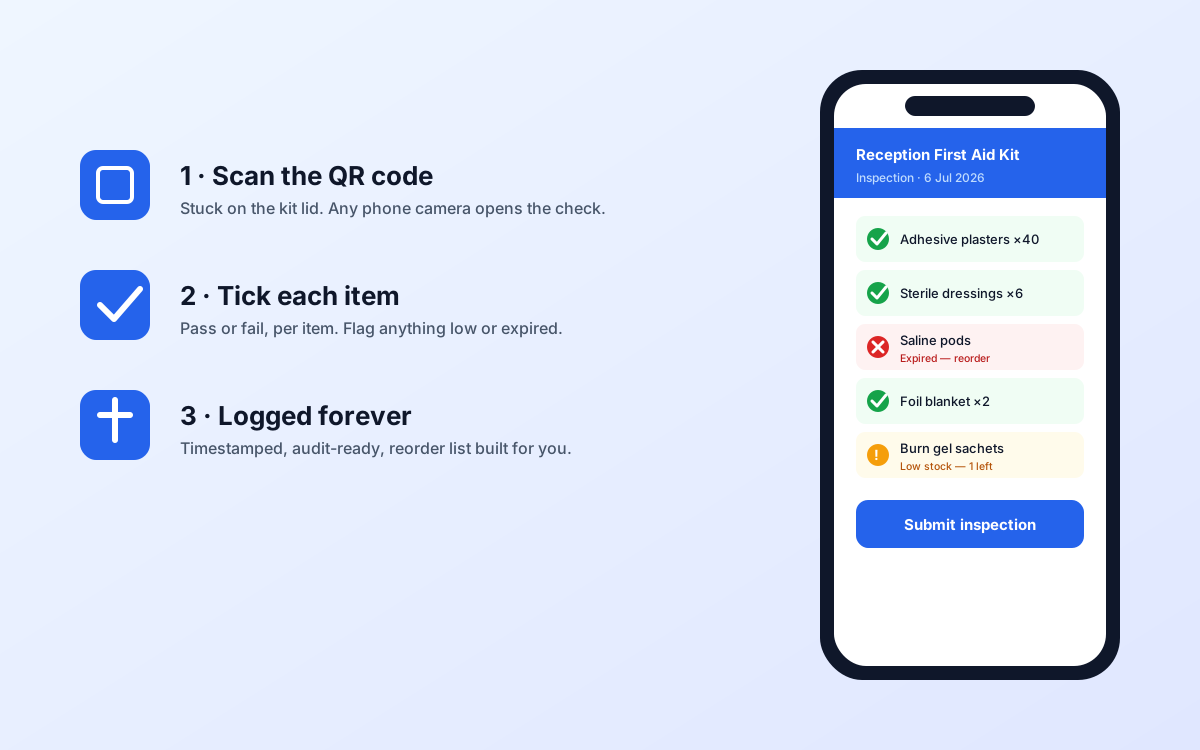
Higher-risk sites have more to track — more kits, more first-aiders, more shifts, more equipment with its own expiry — and that is exactly where factory compliance slips. That's what KitCompliance automates: build each kit from the BS 8599-1 / ISO 45001 suggested list, record inspections in seconds, track certificate and AED-pad expiry, and get reminders before anything lapses — with a one-click report that proves your provision to an HSE inspector or ISO 45001 auditor. See the getting-started guide to set it up.
Frequently asked questions
Is a factory treated as higher-risk for first aid?
Yes. Machinery and moving parts, hot processes, chemicals, pressure systems and heavy manual handling put almost all manufacturing above the low-risk bracket — which means more first-aiders, FAW-level training rather than EFAW, and often extra equipment such as eye wash, burns kits and an AED.
How many first-aiders does a factory need?
There's no fixed ratio — your needs assessment sets it. As a guide for higher-risk sites: at least one FAW first-aider for 5–50 staff and one more per extra 50, counted per shift so nights and weekends are covered too.
Does a factory legally need a defibrillator?
No law makes an AED compulsory, but the HSE strongly encourages one where the assessment supports it — large sites, physical work and long ambulance times all point towards providing one.
What should be in a factory first aid kit?
Base it on BS 8599-1 and headcount — usually large (100-person) kits, several of them, spread across the floor — plus burns dressings near hot processes and eye wash where chemicals or dust are handled.