A shop looks like a low-risk place to work, and much of the time it is — until a customer faints in a queue, a member of staff slips on a wet floor, or someone in the stockroom mishandles a heavy delivery or catches a hand on a box cutter. Retail also has quirks other workplaces don't: shifts are often covered by a single person on the till, the shop is full of members of the public, and a chain may run dozens of stores that all need to meet the same standard. This guide covers what the law actually requires of a shop, how much provision is "adequate", and how to keep it consistent whether you run one store or fifty.
Is first aid a legal requirement for a shop?
Yes — the same law applies to a shop as to any other UK workplace. The Health and Safety (First-Aid) Regulations 1981 place a duty on every employer to provide "adequate and appropriate" equipment, facilities and people so that staff who are injured or taken ill at work can be helped immediately. There's no separate retail rulebook and no minimum staff number written into law. What's "adequate" for a quiet village newsagent is very different from a large department store or a supermarket, and the way you bridge that gap is a needs assessment.
It's worth being clear who the duty protects. Like everywhere else, the Regulations legally cover your employees — not your customers. But a shop is unusual in how many members of the public are inside it at any moment, and the HSE strongly encourages employers to plan provision that can help them too. More on customers below.
Retail is lower-risk out front, higher-risk out back
The trap with retail is treating the whole business as low-risk because the shop floor is. Weigh the two areas separately:
- The shop floor — broadly office-level, lower-risk: slips and trips (wet floors near entrances, trailing cables at promotions), the occasional cut on packaging or a broken display, and people taken ill — faints, chest pain, seizures, allergic reactions — among staff and the crowd of shoppers.
- The stockroom and deliveries — closer to a warehouse: manual handling of heavy or awkward stock, ladders and step stools for high shelving, box cutters and strapping, roll cages and pallet trucks, and stacked deliveries that can topple.
- Specialist departments — some shops add their own hazards: hot surfaces and knives in an in-store bakery or deli, cleaning chemicals in a stockroom, or heavy goods in a DIY or furniture store.
- Violence and robbery — retail has one of the higher rates of work-related violence, and staff may need first aid after an assault or an armed robbery, as well as support afterwards.
A single blanket "low-risk" assessment misses the back of the shop entirely. Assess each area for what actually happens there.
How many first-aiders does a shop need?
There's no fixed legal ratio — it comes out of your assessment. For a low-risk shop floor the HSE's rule of thumb is a starting point: for fewer than 25 lower-risk staff, an appointed person may be enough; for 25–50, at least one EFAW-trained first-aider; and one more for every 100 after that. Where the stockroom pushes an area into higher-risk territory, the numbers rise and the fuller First Aid at Work (FAW) qualification may be the right call. For the full breakdown by headcount and risk, see how many first-aiders you need.
The lone-worker problem
Plenty of small shops run with a single person behind the till — and lone working changes the first-aid picture. If that person is the one who's injured or taken ill, there may be no colleague to help or to raise the alarm. A lone worker still needs a stocked kit within easy reach, and the needs assessment should spell out how they summon help: a phone kept to hand, a way to call emergency services or a nearby manager, and — for higher-risk or isolated sites — a check-in routine. Don't assume a solo shift is low-risk just because it's quiet; the risk is precisely that no one else is there.
First aid for customers
Legally, the Regulations only require you to cover employees, so first aid for customers isn't a strict duty. In practice, no retailer runs a shop that ignores a collapsed shopper, and the HSE explicitly encourages provision for members of the public. Because your shop is full of them, it makes sense to:
- Size your kit and first-aider cover so they can realistically help a customer, not just staff.
- Consider a defibrillator (AED) for larger stores, shopping centres and anywhere with high footfall — a public-access AED can save a life in the minutes before an ambulance arrives.
- Make sure staff know how to summon emergency help fast and can direct paramedics to the right entrance in a big store.
Kits and equipment
Provision follows the assessment, but a typical shop should have:
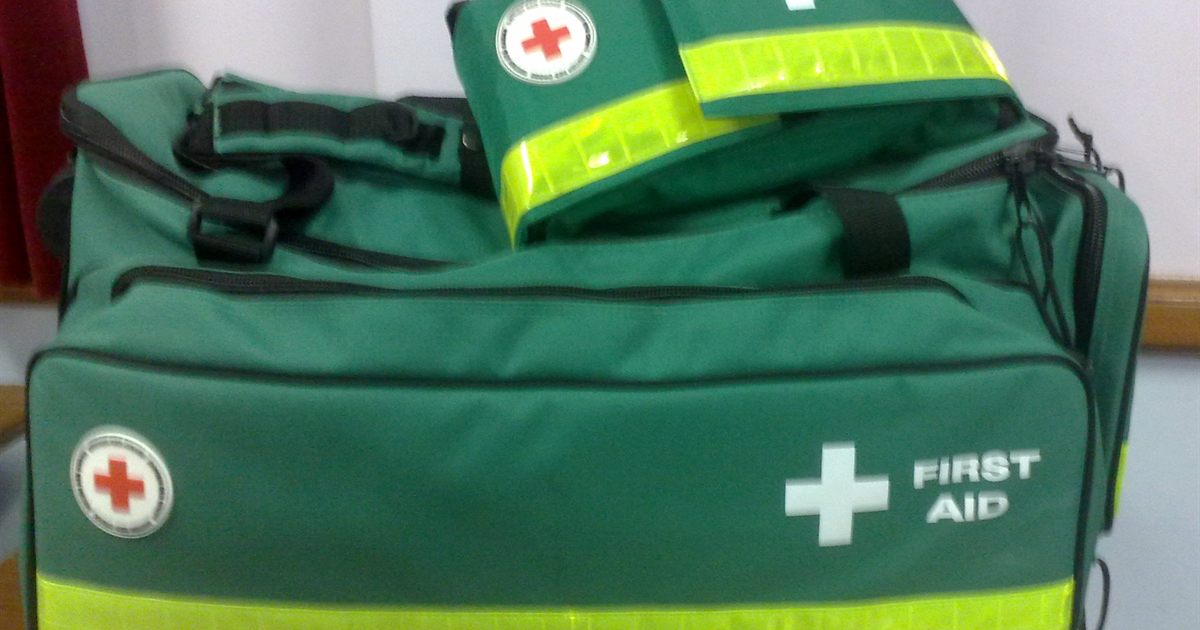
- A BS 8599-1 workplace kit near the till, of the right size for the number of staff and the risk level (see standard kit contents).
- A second kit in the stockroom for larger stores, so help is close to the higher-risk area rather than a long walk across the shop floor.
- Signage — clear signs so any member of staff, including new starters and agency cover, can find the nearest kit and first-aider fast.
- Extra provision for specialist areas — a burns dressing near an in-store bakery, or eyewash where cleaning chemicals are used.
- An AED where footfall and store size justify it.
Records, expiry and inspections
Evidence matters as much as equipment — and in a busy shop, kit checks are exactly what slip. Stay on top of:
- An accident book, and knowing when an injury — a bad fall, a serious cut, a customer taken to hospital — becomes RIDDOR-reportable to the HSE.
- Kit inspections on a set schedule (see how often to inspect) and expiry dates on dressings — easy to overlook when a kit is rarely opened.
- First-aid certificates — FAW and EFAW last three years, so track renewals across a team that changes often, and never let cover quietly lapse on a store.
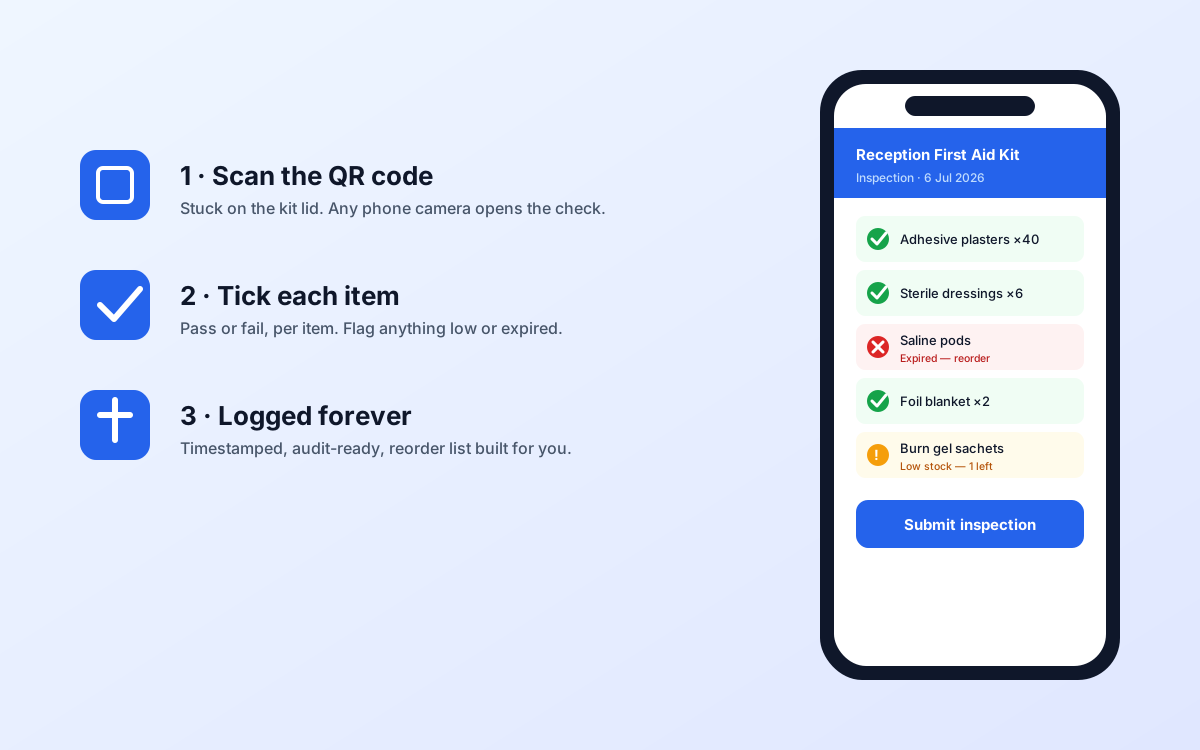
For a chain, this is where paper checks fall apart: a till kit and a stockroom kit in every store, certificates spread across shift workers, and a head office that has no live view of which branch is actually compliant. That's what KitCompliance automates: build each kit from the BS 8599-1 list, log inspections in seconds, and get reminders before a dressing expires or a certificate lapses — with one dashboard across every store and one-click reports to show an HSE inspector. See the getting-started guide to set it up.
Frequently asked questions
Does a shop legally need a first aider?
No law names a minimum number. The First-Aid Regulations 1981 require adequate and appropriate first aid, decided by a needs assessment. A very small, low-risk shop may only need an appointed person to take charge and call for help, but most retailers with several staff, a stockroom or lone-working shifts conclude at least one trained first-aider is appropriate.
What first aid training do retail staff need?
For the low-risk shop floor, the one-day EFAW qualification is usually enough. Where there's a busy stockroom with manual handling and machinery, a needs assessment may point to the fuller three-day FAW course. Both certificates last three years.
Do I have to give first aid to customers in my shop?
The Regulations only legally require you to cover employees, so first aid for customers isn't a strict duty. But the HSE strongly encourages provision for members of the public, and a shop is full of them, so most retailers plan their cover so it can help a customer too.
What should be in a shop first aid kit?
A BS 8599-1 workplace kit sized to your staff numbers and risk, kept near the till. Larger stores or a busy stockroom may need a second kit and a bigger size, plus signage so any member of staff can find the nearest kit and first-aider quickly.
What about a shop where one person works alone?
Lone working raises the risk, because there may be no one to give first aid or raise the alarm. A single-staff shop still needs a stocked kit within reach, and the assessment should cover how the lone worker calls for help — a phone to hand and a way to summon emergency services or a nearby colleague quickly.