Most guidance on workplace first aid counts heads: how many staff you have, and therefore how many first-aiders and kits you need. But the people who get hurt on your premises aren't only employees. Customers slip, a delivery driver cuts a hand, a contractor falls, a visitor collapses. So do you actually have to provide first aid for non-employees — and if the law says no, why does every sensible employer do it anyway?
What the law actually says
Two different laws pull in the same direction here, and it's worth keeping them apart:
- First-Aid Regulations 1981. These are the ones that set the duty to have "adequate and appropriate" kits, facilities and first-aiders — but only for your own employees. On a strict reading, they do not require you to provide anything for a visitor or a member of the public.
- Health and Safety at Work etc. Act 1974, section 3. This is the wider duty: you must conduct your business so that people not in your employment are not exposed to risks to their health and safety. It doesn't spell out "first aid", but it's why ignoring the people who use your premises is not a defensible position.
The HSE resolves the gap plainly in its guidance to the 1981 Regulations: employers are strongly encouraged to include non-employees in their first aid provision. So while a lawyer can tell you the 1981 Regulations stop at your payroll, the practical answer for almost every workplace is: cover them.
Who counts as a "non-employee"?
More people than you might list at first. Your provision should have thought about:
| Group | Why they matter |
|---|---|
| Customers & the public | In shops, venues, gyms and hospitality they are on site in numbers and may outnumber staff at peak times. |
| Visitors & delegates | Meeting guests, interviewees, auditors and event attendees who don't know your layout or where help is. |
| Contractors & agency workers | On site to do work — often the higher-risk tasks — but employed by someone else. Coordination is key (see below). |
| Delivery drivers & couriers | Brief but frequent visitors, often around loading bays and vehicles where injuries happen. |
| Service users, pupils, patients | In care, education and health settings these are the primary people at risk, not an afterthought. |
Contractors: agree it before work starts
Contractors are a special case because they have their own employer, and therefore their own first aid duty under the 1981 Regulations. That does not mean you can ignore them. Before work begins, agree who is providing what:
- Will the contractor bring their own first-aider and kit, or rely on yours?
- Where are your first aid points and signs, and who are the on-site first-aiders?
- How is the emergency services call made, and what's the site address and access point for an ambulance?
On construction and shared sites this coordination is expected and usually written into the site induction and rules. The point is that nobody should discover, mid- incident, that each party assumed the other had it covered.
How to build non-employees into your provision
You don't run a separate exercise for them — you fold them into the first aid needs assessment you already have to do. Three practical adjustments:
- Count realistic numbers on site, not just staff. A 50-seat café with six employees can have 56 people to cover at lunch. Size your first-aider cover and kit locations for the busy case.
- Place kits where the public actually are. Front of house, reception, the shop floor and event spaces — not only the staff room. See where to store first aid kits.
- Consider an AED. A cardiac arrest can strike anyone through your doors. A publicly accessible defibrillator is one of the highest-value additions for a public-facing site.
Recording and reporting treatment for non-employees
If a first-aider treats a visitor or customer, record it the same way you would for an employee — what happened, what was done, when, and by whom. That record protects you if a claim follows, and it feeds the same review loop as any other incident.
Reporting has an extra wrinkle. Under RIDDOR, if a member of the public is injured in connection with your work and is taken directly from the scene to hospital for treatment, that is reportable to the HSE — a threshold that doesn't apply in the same way to staff. Knowing this in advance means you won't miss a report you were legally required to make.
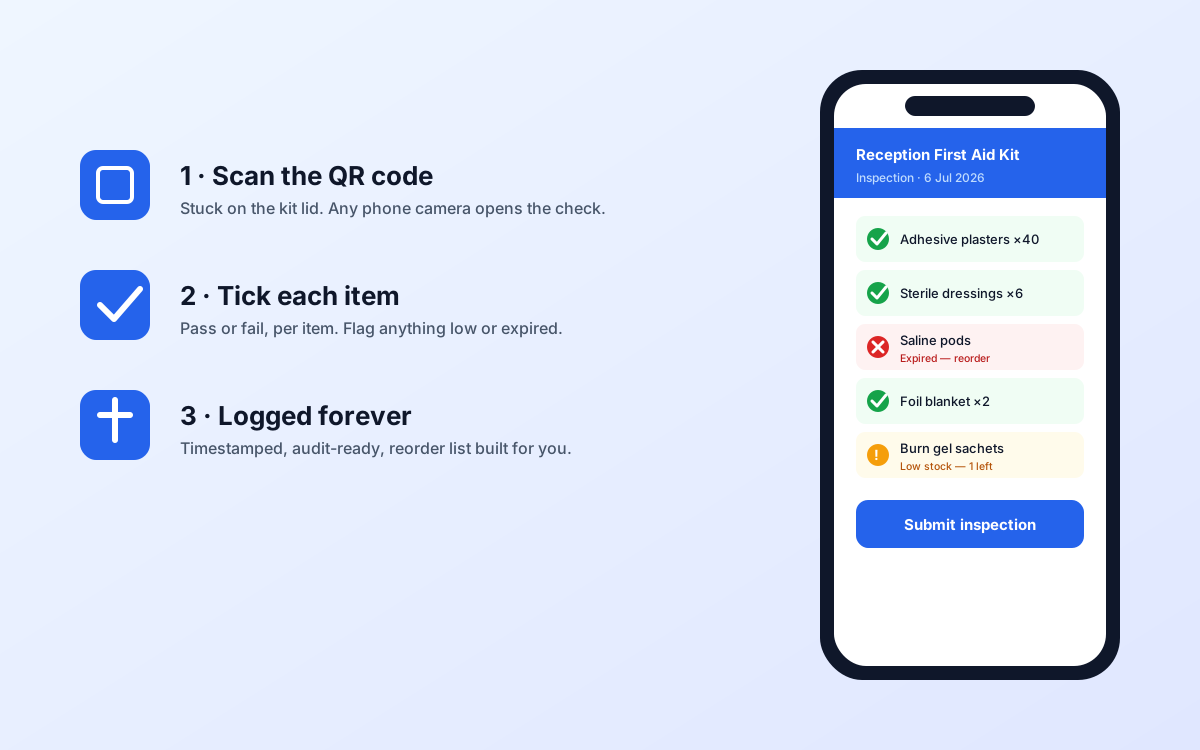
Deciding to cover non-employees is the easy part. The harder part is the same one every workplace struggles with: keeping every kit — the reception one, the shop-floor one, the one by the event space — stocked and in date, and being able to prove it. That's exactly what KitCompliance does: build each kit from the ISO 45001 suggested list, log inspections in seconds, and get reminded before anything expires, with a one-click report that evidences your provision. See the getting-started guide to set it up.
Frequently asked questions
Do I legally have to provide first aid for non-employees?
The 1981 Regulations only require provision for your own employees, so strictly no. But the HSE strongly recommends you cover visitors, contractors and the public, and your section 3 duty under the Health and Safety at Work Act 1974 to protect people affected by your work makes covering them the sensible, expected approach.
Can employees use the first aid kit on a visitor or member of the public?
Yes — and in an emergency they should. Because HSE recommends including non-employees, size your kits and first-aider numbers with visitors and the public in mind, not just staff.
Who provides first aid for contractors on my site?
Contractors are their own employer's responsibility, but agree arrangements before work starts — who covers whom, where the kits and first-aiders are, and how the emergency services are called. On shared and construction sites this is written into the site rules.
Do I have to report first aid given to a member of the public?
Record it as for staff. Under RIDDOR, if a member of the public is injured in connection with your work and taken directly from the scene to hospital for treatment, that is reportable to the HSE.