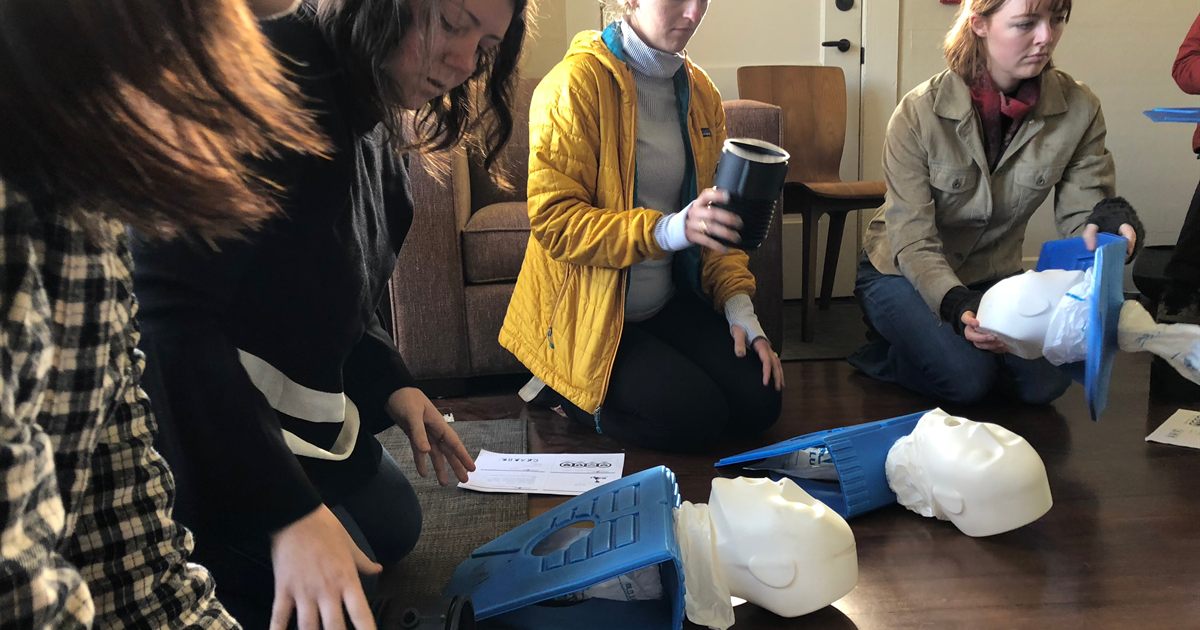
A sudden cardiac arrest is the most time-critical emergency you can face at work. Someone collapses, stops breathing, and their survival is now measured in minutes — for every minute without CPR and a defibrillator, the chance of survival falls by around 10%. Wait for the ambulance and it is almost always too late. Start CPR and get a defibrillator on the chest, and you can more than double the odds. This guide covers how to recognise a cardiac arrest, exactly what to do, and what UK employers should have in place.
Heart attack vs cardiac arrest — they're not the same
People use the terms interchangeably, but the response is different, so it's worth being clear:
| Heart attack | Cardiac arrest | |
|---|---|---|
| What it is | A circulation problem — a blocked artery cuts blood to part of the heart muscle. | An electrical problem — the heart stops pumping effectively and blood flow stops. |
| The person is usually… | Conscious, in pain, may have chest tightness, breathlessness, sweating, nausea. | Unresponsive, collapsed, not breathing normally (or only gasping). |
| What you do | Call 999, sit them down, keep them calm and still, help with any prescribed medication. | Call 999, start CPR immediately and use an AED as soon as it arrives. |
A heart attack can lead to a cardiac arrest, so a casualty who has chest pain and then collapses has moved from one to the other — switch straight to CPR. Not every sudden collapse is a cardiac arrest, though: if the person is still responsive but has a drooped face, weak arm or slurred speech, suspect a stroke and use the FAST test instead, and if they are jerking or convulsing it is likely a seizure — protect them and let it pass rather than starting CPR.
The chain of survival
The UK Resuscitation Council describes cardiac arrest survival as a "chain of survival" — four links that each have to happen fast:
- Early recognition and call for help — spot the arrest and dial 999 without delay.
- Early CPR — chest compressions keep oxygenated blood moving to the brain.
- Early defibrillation — an AED can restart a normal rhythm, and works best in the first few minutes.
- Post-resuscitation care — the ambulance crew and hospital take over.
The first three links are the ones your workplace can influence. That is why fast recognition, confident first-aiders and a defibrillator within reach matter so much.
How to give CPR at work, step by step
This follows current UK Resuscitation Council guidance for an adult. It's the same sequence you'll practise on a course.
- Check the scene is safe. Don't become a second casualty — look for hazards such as live electricity, traffic or machinery first (see electric shock first aid if that's the cause).
- Check for a response. Kneel beside them, shout and gently shake their shoulders: "Are you all right?" No response means they're unresponsive.
- Open the airway and check breathing. Tilt the head back, lift the chin, and look, listen and feel for normal breathing for up to 10 seconds. Occasional slow, noisy gasps (agonal breathing) are not normal breathing — treat as cardiac arrest.
- Call 999 and get the AED. If they're not breathing normally, call 999 now, put it on speaker so you can keep your hands free, and send a colleague to fetch the nearest defibrillator.
- Give 30 chest compressions. Place the heel of one hand in the centre of the chest, the other on top, fingers interlocked. Keep your arms straight and shoulders over your hands. Push down 5–6 cm at 100–120 a minute (the beat of "Stayin' Alive"), letting the chest come all the way back up between each push.
- Give 2 rescue breaths. If you're trained and willing: pinch the nose, seal your lips over their mouth and give two steady breaths, watching the chest rise. If you can't or won't, skip this and give continuous hands-only compressions — that's still hugely effective.
- Repeat 30:2. Continue cycles of 30 compressions to 2 breaths without long pauses. Swap with another rescuer every 2 minutes if you can — good compressions are tiring.
- Use the AED the moment it arrives. Turn it on and do what it says (below). Restart CPR immediately after any shock or "no shock" message.
Keep going until the ambulance crew take over, the person clearly wakes up and starts breathing normally, or you're too exhausted to continue. Don't stop to "check" every couple of cycles — interruptions cost lives.
Using a defibrillator (AED)
A public-access or workplace AED is built for anyone to use — it talks you through every step and will only shock a heart rhythm that needs it, so you cannot shock someone by mistake. When it arrives:
- Switch it on and follow the spoken and visual prompts.
- Expose the bare chest and attach the pads as shown on the pad diagrams (one below the right collarbone, one on the left side below the armpit). Dry the skin if it's wet.
- Stand clear while it analyses — make sure no one is touching the casualty.
- Deliver a shock only if told to, making sure everyone is clear, then immediately resume CPR for 2 minutes until it prompts you again.
What UK employers should have in place
There's no single regulation that says "you must be able to handle a cardiac arrest", but the duty falls out of the Health and Safety (First-Aid) Regulations 1981, which require "adequate and appropriate" provision. Your first aid needs assessment is where you decide what that means. Work through:
| Provision | What to put in place |
|---|---|
| Trained first-aiders | Enough first-aiders with current CPR and AED training, covering every shift — a collapse at 2am needs the same response as one at midday. |
| A defibrillator (AED) | Strongly recommended for larger sites, those with the public in, gyms and leisure, and anywhere far from an ambulance. Signed, accessible and maintained. |
| A way to call for help fast | Everyone knows how to dial 999, where the AED is, and how to direct the ambulance in — especially on large or gated sites. |
| Refresher practice | CPR is a perishable skill. An annual refresher keeps first-aiders sharp between three-yearly requalification. |
| Recording & reporting | Log the incident in your first aid record and accident book, and report under RIDDOR if it was work-related. |
After the emergency
Once the ambulance has taken over, there's still work to do. Record what happened while it's fresh — time of collapse, when CPR started, whether the AED delivered a shock — in your first aid treatment record. If the arrest was caused by a work activity, check whether it's reportable under RIDDOR. Restock anything used, and replace AED pads straight away — a used set leaves the unit unready for the next emergency.
Don't overlook the responders. Performing CPR on a colleague is distressing whatever the outcome. Offer a debrief and support to everyone involved — it's part of a first-aider's duty of care to themselves as well as others (see first aider duties & responsibilities).
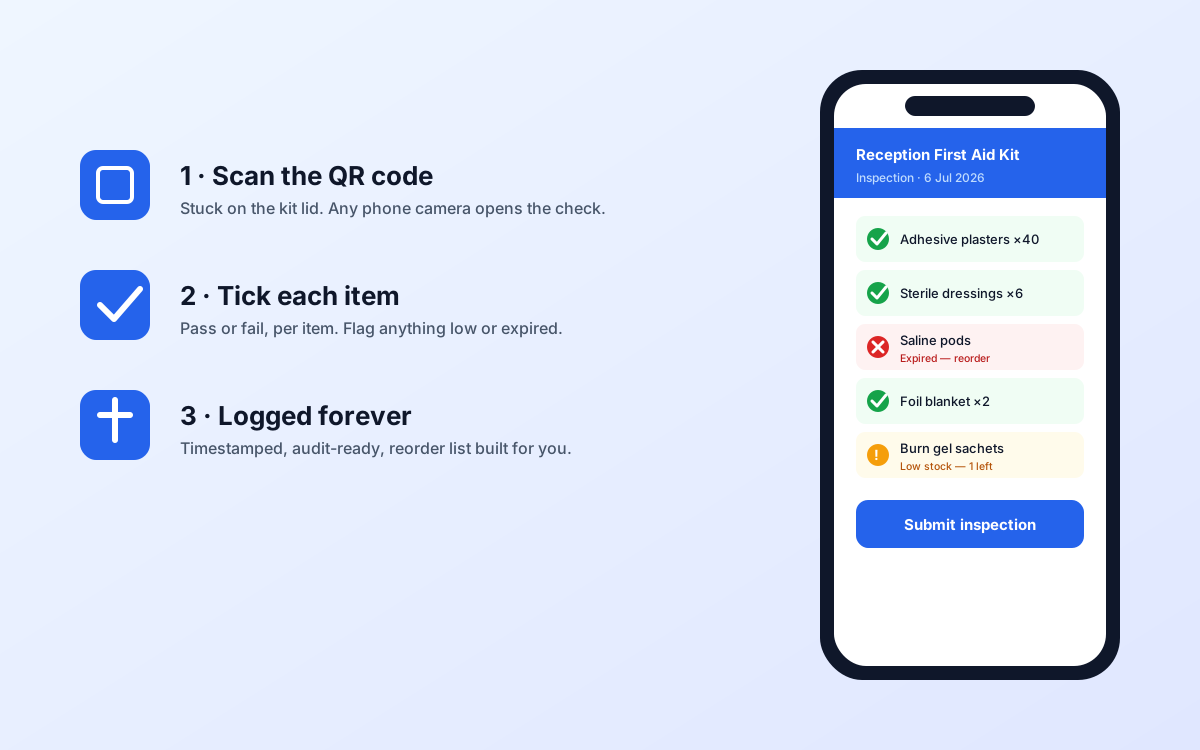
Knowing the CPR sequence is half the battle; the other half is making sure the equipment is ready when you need it. That's what KitCompliance does: track every AED, its pad and battery expiry, and every first aid kit alongside it, log the weekly and monthly checks in seconds, and get reminders before anything lapses — with a one-click report that proves your provision. See the getting-started guide to set it up.
Frequently asked questions
What's the difference between a heart attack and a cardiac arrest?
A heart attack is a circulation problem — a blocked artery — and the person is usually conscious with chest pain. A cardiac arrest is an electrical problem where the heart stops pumping, so the person collapses, is unresponsive and stops breathing normally. A heart attack can trigger a cardiac arrest. Cardiac arrest needs immediate CPR and a defibrillator.
Do you have to give rescue breaths, or is hands-only CPR enough?
If you're trained and willing, give 30 compressions to 2 rescue breaths. If you're untrained, unwilling or unable to give breaths, give continuous hands-only compressions instead — it's far better than doing nothing. Push hard and fast at 100–120 a minute and don't stop until help arrives.
Do UK workplaces legally have to provide a defibrillator?
There's no blanket legal duty, but the 1981 Regulations require "adequate and appropriate" provision decided by your needs assessment. Where staff numbers, the public, or distance from an ambulance raise the risk, an AED is strongly recommended and increasingly expected.
Can you be sued for giving CPR or using a defibrillator?
In practice, no. A first-aider acting in good faith is very unlikely to face a claim, and the Social Action, Responsibility and Heroism Act 2015 protects people who step in to help. An AED will only shock a rhythm that needs it. Doing nothing is the real risk.
Is a cardiac arrest at work reportable under RIDDOR?
It can be. If it was caused by a work activity and results in death or a specified injury, it's reportable. A cardiac arrest from a purely personal medical cause, unconnected to the work, generally isn't — but always record it in the accident book and first aid log.